Mapping our changing relationship with the wetlands
By Helen Shaw, Tóchar Stories
It was poet Jane Clarke who came up with the title ‘Where the Curlew Calls’ for our podcast and the Tóchar Stories book we’re bringing together for publication with Lilliput Press in 2027. Jane, who grew up surrounded by bogs in rural South Roscommon, collaborated with us on the Between the Sights of the Sun event in the Seamus Heaney exhibition at the National Library in July last year and she has written an essay for the book retracing her own roots with the bogland through a walk at Cloonlarge Bog, Kilteevan – a nature reserve and bog trail where we have been working with the local community across the last two years.
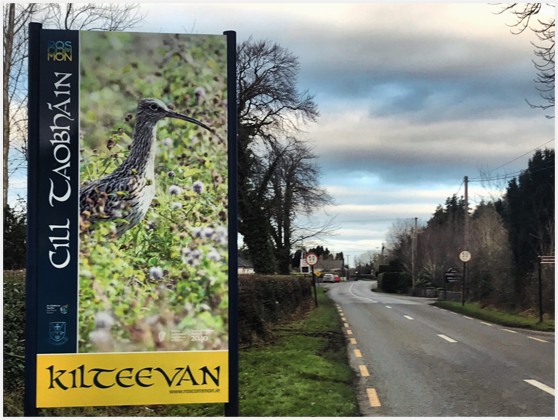
When you enter the village of Kilteevan there’s a beautiful placemaking sign featuring the curlew as its icon (an initiative by the unstoppable Eileen Fahey) and Jane was lucky enough to hear one at the end of her walk.
In her essay for the forthcoming book Jane writes: “Though only seven miles from my childhood home, I’ve never been on Cloonlarge Bog before. It lies close to Roscommon town at the north-western corner of Lough Ree between the Clooneigh and Hind rivers. The first sound I hear when I step out of the car is the churring of the mistle thrush. Within a hundred yards I’ve been regaled by coal tits, blue tits, robins, blackbirds galore, the harsh alarm call of a magpie, hooded crows and woodpigeons. As I walk along the narrow grass-lined byroad I hear water in the streams on either side, burbling loudly after all the rain this winter”.
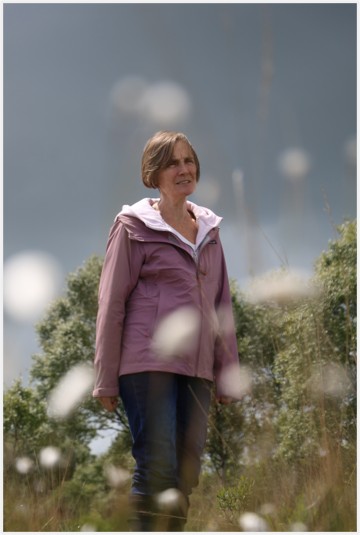
- WATCH : Jane Clarke at Bogland -Between the Sights of the Sun on her own changing relationship with the bog
Jane is one of the writers we have asked to document their changing relationship with the bogs, peatlands and wetlands of the Midlands. Another is the renowned Co Offaly author, botanist and geographer John Feehan whose keynote speech at the launch of Tóchar Wetlands Restoration has been published as a Tóchar pamphlet ‘Thinking like Mountain’ and it takes inspiration from the critical work of the American naturist and writer Aldo Leopold. John has been busy working on the wildflowers of Offaly video series for Offaly Heritage with nature photographer Tina Claffey and Tina has captured some wonderful portraits of John for the book.
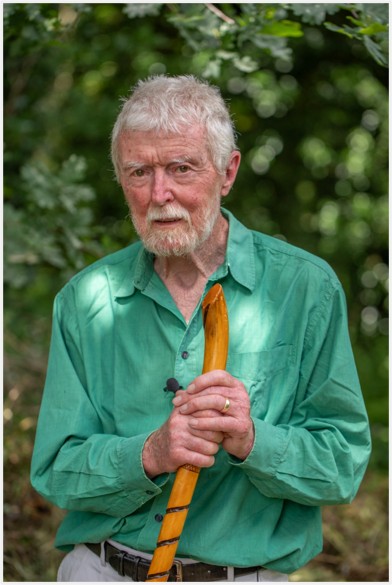
In the conclusion of ‘Thinking like a Mountain’ John writes
“As we reflect on the enormous challenges we face in our time, it is easy to feel helpless, that there is little we can do apart from using the influence of our voice and vote to get those who represent us politically to echo all our voices on the national and international stage. But we are often reminded of the importance of connecting what is a global challenge back down to our local environment. The first step is to bring these areas within the embrace of the community living around the bog, whatever the measures we take to facilitate their progress towards the future of optimal biodiversity to which their ecological succession is taking them”.
Tina Claffey, an award-winning macro photographer, is contributing her own work to the book in a photo essay, and Tina worked with us in the Tóchar Stories community storytelling day with the Kilcormac Community ‘Sharing our past, imagining our future’ last September. Journalist and broadcaster Ella McSweeney is another of our commissioned essay writers. Ella has written powerfully about why we need to value our bogland and how it can offer us not just increased biodiversity and stunning places to experience nature but how they can provide us with climate solutions and help secure our future by storing carbon emissions.
In an Irish Times feature Ella wrote: “Bogs have offered us so much, and many are now lost forever. For the small fragments that remain, it’s a blessing that we can at least attempt to bring them, in Feehan’s words, “back to the local embrace”. Their story – one of abundance and life – will continue; all they need is for us to step back and allow time to do its work”.
The Tóchar Stories ‘Where the Curlew Calls’ book is about the ways in which people and places – like Kilteevan, in Roscommon – are guardians of nature, and how the welfare of people and places is interwoven with that of nature. Community champions and custodians including Eileen Fahey, Eugene Dunbar in Tyrrellspass and Marie Gilmore in Galway’s Living Bog are writing their own personal take on the theme of changing relationships with the land and how we value it.
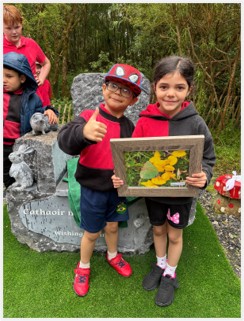
It was lovely on June 22nd to see the children of Kilteevan NS, who we worked with a year ago to create the butterfly and bog art project with artist Annie Holland, celebrating their end of school year with a gathering on Cloonlarge Bog where Eileen and the Kilteevan Tidy Towns marked the arrival of a new sculpture piece, a wishing chair, by local artist Mark Feeley. Mark also created the gigantic Gulliver on Lilliput Way, the playful fairy loop designed with children and families in mind.
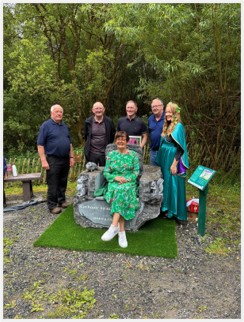
Photo: Eileen Fahey with Kilteevan Tidy Towns members and the artist Mark Feeley (Photo Eileen Fahey)
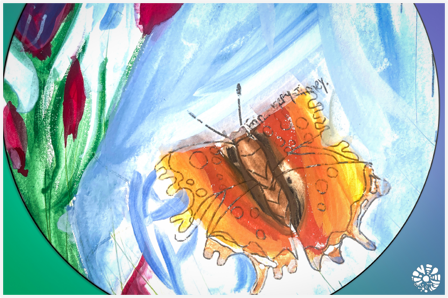
We have had the privilege of working with four primary schools across the region and the illustration we’re using for the Where the Curlew Calls poster is actually by one of the children, Erin Halferty Tinney, in St Anne’s NS Tyrrellspass, Westmeath. You can see the St Anne’s project if you take a stroll on Cloncrow Bog as the children’s art – made with guidance from Eugene Dunbar, artist Annie Holland and their teacher Laura Lynch – greets you at the entrance to the trail.
For more :
- You can listen to the emerging ‘Where the Curlew Calls’ audio podcast series on Spotify and Soundcloud and watch the video showcase on vimeo. Follow us on Instagram as we continue to find and tell the stories of people, places and nature and map our changing relationship with the wetlands @tocharstories.