
By Helen Shaw, Tóchar Stories
From my first encounter with Eileen Fahey, of Kilteevan Tidy Towns in January 2025, Eileen urged me to talk with Gertie Murphy – one of their oldest volunteers. But it was November before we finally got to meet in Gertie’s house and to audio record with her. By chance it’s just before Gertie’s ninety-first birthday so luckily I’ve brought a plant knowing how much she loves nature and flowers. At 91 Gertie is increasingly physically frail but her mind and memory are sharp.
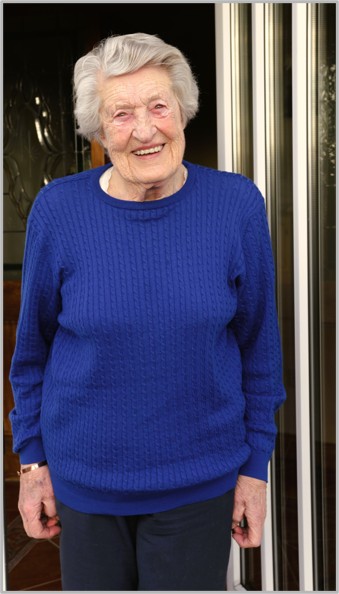
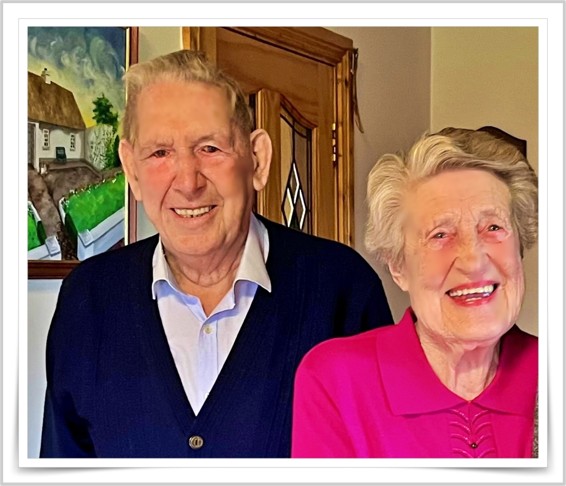
On the day we meet she is a little sad as we had hoped to record with both herself and her husband Mattie, another veteran volunteer with Kilteevan Tidy Towns, but by then Mattie had had to move to a nursing home. Time is precious for all of us and sometimes recording someone’s life story becomes a way of conserving a sense of who we are and what has made us.
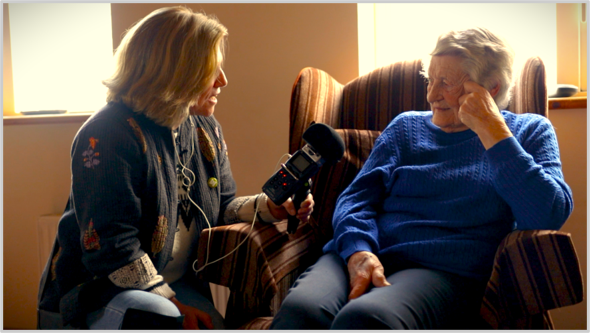
Gertie is a gifted storyteller. She immediately pulled me into the world she grew up in and like all good aural storytellers paints pictures.
“I got married in 1963. If you see that house down there, I got married into that house. I worked in town and I cycled on my Raleigh bike every morning, hail, rain, or snow. It’s why I have lots of arthritis today from all the wetting I got. When I’d come home from work in the evening, I’d have something to eat, and I’d get back up on the bike again into the bog to make up turf. That went on most of the summer, really. Well, between cutting turf, rearing it, making it up, as we used to say, bringing it out, and bringing it home, most of the year was gone. It really was. But the cutting of the turf was the best part of it because of a meitheal. Did you ever hear tell of ‘a meitheal’?”, she asked me. I did, I said, and thought how often older country people have mentioned meitheal – an ancient Irish word for the way neighbours would come together to help each other at harvest, turf-cutting or when times were hard.
Gertie’s memory went back to those days when times were impoverished and people had little – but what they had was meitheal. “There’d be a meitheal in the summertime with the cutting of the turf. The neighbours would come. But it was a very hard week on the housewife because the poor housewife had to do all the baking and all the men had to be fed in the bog. So you had to pack up the sandwiches, tea. The tea would be brought in five naggin bottles. And what kept it warm?”, she asked me with a glint in her eyes.
“What did you use?”, I asked. She beamed laughing, “A man’s sock!”
“You put the bottle down into the man’s sock, and that tea was as warm when you landed in the bog as it was when you left. That’s how we spent our youth”.
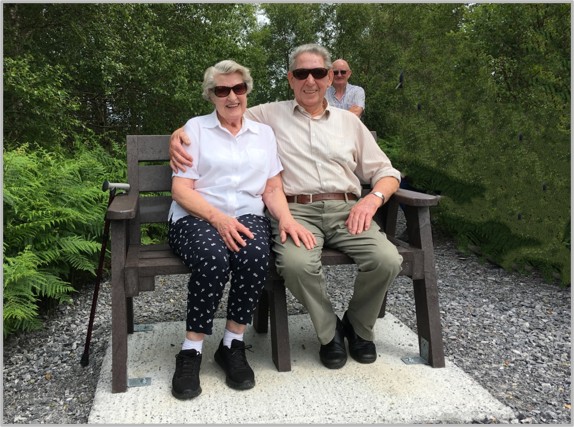
While Gertie remembers hard days working in the bog, bringing the turf home for fuel, in recent years she has come to see the bogland anew – as a place for nature, of peace and beauty. Once Eileen began to get the local Tidy Towns involved in bog conservation Gertie, and Mattie, were on hand – delighted to see the Cloonlarge Bog loop develop for local people to enjoy
Like many she’s keen to reflect on everything the bog has given to the local people. “You could say it educated the youth of Kilteevan. You’d say, How? By cutting turf and selling loads of turf. There were lots of children educated like that. They all went through college through the bog, and it was the bog that brought them there. Otherwise, they wouldn’t have been. While we owe it a lot, it has given a lot to us. I must say it has given a lot”.
For Gertie there’s two ways to look at the past – at the hard, hungry days of Ireland particularly in the 1930s, 40s and 50s – and how people live today. Then you had nothing but the community wrapped around you. Today, Gertie feels, people have everything but they don’t have community and meitheal.
“You had the meitheal then. And that covered a lot. I mean, they all came and they all worked. And they worked as hard for me as they did for you and as they did for themselves. There was nothing between them at all. They all seemed to work so hard. And then, you see, which was a great thing too, in later years, you went to the pub and you got the jar, you know the jar, the crockery jar, whatever kind of a jar it was. You got that and you got that full of port. And sure they were away with it then when they had the few pints!”.
Those memories of the social gatherings after a hard working meitheal gathering made Gertie remember the rambling house tradition where, in the community, there was often a house or two where the door was always open and where people gathered for conversation, song and even a dance. Like meitheal stories of the rambling house tradition come up across the country. At a time where entertainment was something you made yourself – a rambling house was often the heart of a community. Gertie talked of Kilteevan homes that were famous for it and vividly brought us back to that time.
“A rambling house was an open house. Walk in anytime you like, day or night, and you go, no knock, no nothing. Open the door and walk in. You went in, you pulled up a chair to the fire, and you sat down. Everyone would go into that house at night, and the house would be full. It might end up with a card game, or it might end up with a dance, depending on the humour. It depended on who was there, if there was a musician, you were away with it. If you had a musician, you were sound. ‘Oh, pull back the table’ -the table would be pulled back and the chairs and you belted it out on the floor there and then you sat down to rest and then ‘you sing a song’ and ‘you sing a song’. And anyone that was asked to sing a song, automatically started off and there was no person saying that ‘I won’t’ or ‘I can’t’ or not at all. Everyone sang”.
But meitheal and the rambling house spirit were how people survived in hard times. When Gertie was just four years old her father died leaving her mother with five small children to rear. “No pension, no children’s allowance, no nothing. My 12 year old brother left school to look after us; to try and make a living. Things were very scarce. There was no money. Nobody had any money”. She remembers people coming to the door to take her and her baby brother into care, into an orphanage, but her mother Margaret blocked the door and said “over my dead body do you take my children”.
Today Gertie wishes Ireland’s contemporary prosperity can marry with old values like meitheal – and for rural places like Kilteevan to see new life. “You’d love to see a lot of young people coming back…There is lots of places there to be got. And why they can’t come and settle here, I don’t know. And give a bit of life to the parish”.
As I leave and thank her, I ask Gertie for her secret for staying well into her nineties. Was it all the cycling? “Oh, and dancing. Sure, I’d still love to dance if I was able. I love dancing…We went a good bit to Longford dancing, until Covid. Covid, bad cess to Covid anyway. It ruined the country”.
That image of Mattie and Gertie dancing together well into their eighties will stay with me whenever I think of them.